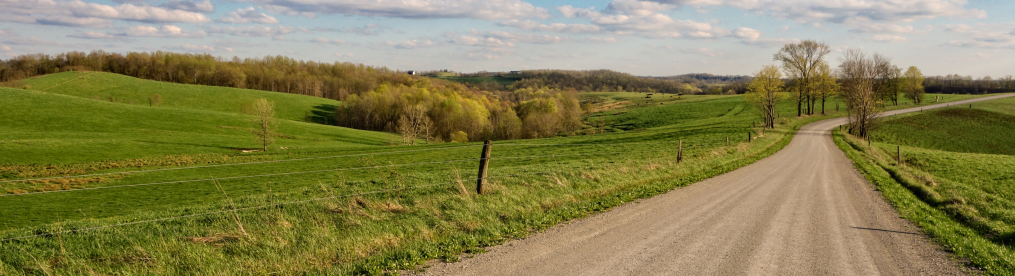
Excursion 15, Part 4 (The Golden Hour)

In which our intrepid hero finds himself homeward bound as a long day winds down…

This blog is all about journeys and explorations.  Most visibly, it is about me exploring different parts of Ohio and recording what I see.  It is also about me exploring photography itself and trying to become a better photographer, despite my inherent limitations (such as considerable impatience).   I have been trying to educate myself on cameras, on photography, and, more recently, on post-processing and HDR.  From the vantage point of this writing, in early February 2014, some six months after these photographs were taken, I have seen improvement on my part and I hope there will be more.

Landscape photographers like to refer to the early morning or the time around sunset as “golden hours,” because the light is a soft, warm light that lends itself to attractive photographs, and because the dynamic range of light at those hours is close to what cameras can naturally reproduce.   An alien anthropologist who studied Earth only through its landscape photography might be forgiven for thinking that Earth was a planet of perpetual sunset.

Continue reading

Excursion 15, Part 3 (Sins of a City)

In which our intrepid hero explores a town under shadow…

One of the more prominent rust belt towns along the Ohio River is Steubenville.  Most Americans had never heard of this town until 2012.  That year, a horrifying news story emerged from Steubenville.  A group of high school students, including members of Steubenville High School’s vaunted football team, sexually assaulted a teenaged girl at a party.   Steubenville adults were nowhere to be seen, it seems, as groups of students drank heavily at various parties around town.  The victim, already drunk, left one party to go to another, accompanied by a handful of football players.  There she drank even more and became incapacitated.  After a while, the group left the party to go to a third, and then to someone’s home.  In the car, one of the assailants removed the victim’s shirt and sexually assaulted her, while others took pictures of the assault.  At the house, the assailants took off the rest of her clothes, then two of them sexually assaulted her again.  Once again, the whole incident was caught in pictures.

What followed was as shameful as the initial assault.

Continue reading

Excursion 15, Part 1 (Up the Old Ohio)

In which our intrepid hero travels up a lazy river…

Typically, in introductions to blog entries such as this one, I have tried to evoke personal memories of years long since gone, but recently, the only memories easily evocable have been dreams of only a few short months ago, those naïve times before I had ever heard of terms like “polar vortex.”  After several years of very mild winters, the winter of 2013-2014 has been a shock to my system I still have not quite gotten used to.  Although we’ve had years with more snow, in terms of pure coldness, this is the nastiest winter we’ve had here in Ohio in 20 years and I guess I was getting spoiled.  As I type, though, the temperature is around 11 degrees, it has been snowing, the wind is whipping outside my window, and the forecast is telling me that two days from now the high temperature will be below zero and the low somewhere around 15 below.  In times like these, I can look at photographs such as these from early August 2013 and almost feel the warmth coming from them.

Continue reading

Excursion 14, Part 4 (Alone in East Liverpool)

In which our intrepid hero explores the empty streets of East Liverpool…

I was 21 in 1988 when I learned I would be moving to Ohio (to go to graduate school).  I knew nothing about Ohio.  The mental image I had was a jumble of snow storms and rubber factories, all with healthy sprinkling of “Rust Belt.”  I discovered, of course, that Ohio is a wonderful and varied place—this blog itself is sort of an ode to the state.  But it is certainly true that there is a Rust Belt and certainly true that Ohio is one of the states at its center.  Ohio cities like Akron, Youngstown, Toledo, Dayton, and others were thriving industrial cities.  Ohio boasted steel mills, automobile factories, all sorts of heavy industry.  Much of that is gone now and although new technologies and new businesses have replaced much of the heavy industry that went to Japan or Korea or China, Ohio has still not recovered from this transformation and probably never will.  Many of the people who had steady factor jobs will simply never make the leap to an information-based economy.  Few assembly line workers can become computer programmers.  Ohio will always have this hole in it, I think.

Continue reading

Excursion 11, Part 3 (Motor Castles for Motor Carriages)

In which our intrepid hero encounters much roadside lodging of a bygone era…

Every frequent traveler has their hotel stories to tell.  One little one of mine comes from a trip to Little Rock, Arkansas, in the 1990s.  I walked into my hotel room to discover that there was an agitated bee in the hotel room.  That was a little disconcerting.  I am not afraid of bees but I respect them and being in the same hotel room as one struck me as being a mite too close for comfort.  So I called down to the front desk and told them to send someone up with some bugspray.  Eventually a hotel staff member arrived but he didn’t have any bugspray.  How the hotel expected him to kill the bee was beyond me.  What he did have was bug-eyes and I soon discovered the reason that he was so fearful was because he was, allegedly, allergic to bee stings.  “So the hotel sent the one guy allergic to bee stings to come kill my bee?” I asked.  “And didn’t give him anything to kill it with?”   We saw, eventually, that more than anything the bee just wanted out of there—he kept trying to get out through the window (which did not open).  So finally we decided to team up—one of us trapped the bee in some of the window curtains while the other thwacked him with a book (probably the hotel room bible).  Final score:  Bee 0, Two Idiots 1.

Continue reading

Excursion 10, Part 1 (My Baby Thinks Three’s A Train)

In which our intrepid hero discovers a three-tiered transport…

One of the fringe benefits of a hobby like this is that it adds an extra flair to many mundane activities.  For example, a friend of mine who lives in Troy, Ohio, invited me over on June 8 to play a strategy game.  Troy is a town north of Dayton that is perhaps 75 minutes away from Columbus via the Interstate.  But if I left several hours early, I could use back roads to get some picture taking before I got there, which is what I did.  Now I wasn’t simply trying to get from Point A to Point B, I was also having an experience.

Continue reading

Excursion 9, Part 3 (Shack Attack)

In which our intrepid hero experiences the concord of (New) Lexington…

In America, there is a great gulf between rich and poor.  Even greater than the gulf in income, I think, is the gulf in empathy and understanding.  Most middle class and an even greater number of wealthy people have no personal experience in what it is like to experience poverty—statistics clearly show that social mobility in the United States is not very high (in fact, among developed countries, the U.S. has one of the lowest rates of social mobility).  I myself am in a somewhat unusual position.  Twice in my life I have experienced extended periods of poverty, while currently I have a comfortable middle class income.  Moreover, because of the university I did my undergraduate work at and because of the job I currently hold, I have met or been friends with many people far wealthier than me, including a couple of billionaires.

Continue reading

Excursion 9, Part 1 (South by Southeast)

In which our intrepid hero discovers people making hay while the sun shines…

Southeast Ohio has always appealed to me.  Geographically, it is one of the most interesting and diverse parts of Ohio.  It is also of cultural interest: Southeast Ohio in many ways is the heart of Appalachian Ohio (though strictly speaking, it is only one of three regions in the state that are technically considered Appalachian Ohio).  Appalachian Ohio is sparsely populated (the largest city in all three regions is Youngstown, Ohio, and the next largest city has fewer than 50,000 inhabitants) and economically depressed (especially Southeast Ohio; most of its counties are considered economically “at-risk” or even “distressed”).   Appalachian Ohio was originally settled by the same demographic groups of people who settled western Virginia and eastern Kentucky and as a result shares most of the elements of Appalachian culture with the Appalachians of other states.

Continue reading

Excursion 7, Part 5 (Springfield in Spring)

In which our intrepid hero takes some time to soak in some Springfieldian sights…

On my way back home, I passed through Springfield, a town about 30 minutes west of Columbus.  The light was already fading, but Springfield is such an interesting town that I decided to take at least a few pictures anyway, though I will certainly come back for a more extended sojourn (in better light).  Of course, the same things that make Springfield interesting to me may seem undesirable for others.

Continue reading

Excursion 6, Part 1 (Passing Through Linden)

In which our intrepid hero drives on Cleveland rather than to it…

My sixth excursion was a trip primarily in northeast central Ohio.  Rather than take the quick way out of town, I deliberately headed north out of Columbus on Cleveland Avenue, so that I could take some pictures of Linden on the way out.  Linden (a neighborhood in Columbus, divided into North Linden and South Linden) is considered one of the “worst” areas of Columbus (“the Bottoms” in Franklinton is right up there, too).  South Linden is considered worse.  Income levels are about half of the Columbus average and crime is higher, too.  Cleveland Avenue is the main “drag” that passes north through and bisects Linden.  One can readily see signs of blight driving up Cleveland Avenue.  There have been various attempts to reinvigorate Linden, especially South Linden, but they have had mixed success at best.  And yet, it is important to note that “blight” is relative.  Let me illustrate what I mean.

Continue reading