Excursion 9, Part 2 (Every Knee Shall Bow)

In which our intrepid hero encounters various signs of religious inclinations…

It goes without saying that religion is a touchy subject, as many deeply held beliefs can be.  My own perspective on religion is slightly unusual.  I was raised Catholic in a city with a significant Catholic population.  However, I still remember from my childhood being passed anti-Catholic comic books published by Jack Chick and being told by one Baptist that I was going to go to Hell for being a Catholic.  I became aware of religious prejudice at an early age.  However, religion did not “take” with me.  By the time I was an adult I had become an atheist.  Yet I always had a great many friends and relatives from a variety of religions whose opinions and perspectives I greatly respected.  Later, as I began professionally to get into the arena of studying (and combating) extremism, I became even more familiar both with religious prejudices as well as prejudices against people because of their religion.   And for more than a dozen years I have been working for a civil rights organization dedicated to fighting against such prejudices.

Continue reading

Excursion 9, Part 1 (South by Southeast)

In which our intrepid hero discovers people making hay while the sun shines…

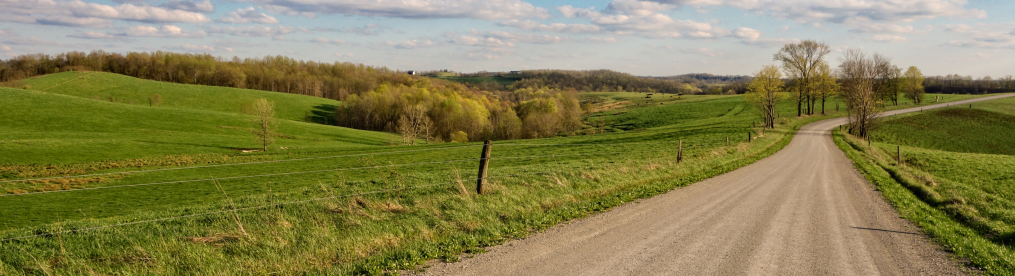
Southeast Ohio has always appealed to me.  Geographically, it is one of the most interesting and diverse parts of Ohio.  It is also of cultural interest: Southeast Ohio in many ways is the heart of Appalachian Ohio (though strictly speaking, it is only one of three regions in the state that are technically considered Appalachian Ohio).  Appalachian Ohio is sparsely populated (the largest city in all three regions is Youngstown, Ohio, and the next largest city has fewer than 50,000 inhabitants) and economically depressed (especially Southeast Ohio; most of its counties are considered economically “at-risk” or even “distressed”).   Appalachian Ohio was originally settled by the same demographic groups of people who settled western Virginia and eastern Kentucky and as a result shares most of the elements of Appalachian culture with the Appalachians of other states.

Continue reading

Excursion 8, Part 7 (The Flatlands)

In which our intrepid hero enjoys the pleasures of the horizontal plane…

There’s more than one type of flat.  First, there’s Western Flat.  Western Flat may be very flat and it may be very flat for a very long way but typically there are mountains in the distance.  Among other things, this allows you to orient yourself.  Then there is Closed In Flat.  That’s when the country is flat but vision is obscured by buildings and/or trees.  When I moved from El Paso to Columbus I went from Western Flat to Closed In Flat.  You lose your bearings in Closed In Flat because there is nothing you can see with which to orient yourself.  I easily get lost in Closed In Flat if I am not familiar with the area.  Lastly, there is Open Flat.  That’s just plain flatness to the horizon.  Northwest and North Central Ohio is primarily Open Flat.  No hills, not much woods, just a lot of farmland.  That’s what I was driving through on this, the final leg of my eighth excursion.

Continue reading

Excursion 8, Part 6 (Justice for Jake and Ella)

In which our intrepid hero discovers a mysterious death…

There was a poll conducted not long before I write this (in late August 2013, three months after this excursion), in which the pollsters gleefully revealed that a substantial percentage of Louisiana Republicans blamed Obama for the failure of the federal government in dealing with Hurricane Katrina.  The point, of course, is that Obama was not even president at the time, but rather a freshman senator from Illinois who had nothing to do with Katrina, good or bad.  What I think this speaks to more generally is how flexible people can be—flexible in terms of things ranging from memory to burdens of proof—when something they want to be true (or not true) is on the line.  Think of conspiracy theorists, for example.  Pick a conspiracy theory:  UFOs, the Kennedy assassination, the New World Order, 9/11, you name it.  Conspiracy theorists generally impose an impossible burden of proof to accept contentions by non-conspiracists while simultaneously lowing all barriers of critical thinking when it comes to accepting contentions or evidence from like-minded people.  This is true for more than simply conspiracy theories or political beliefs; it actually happens quite a bit in ordinary life as well.

Continue reading

Excursion 8, Part 5 (Camp Perry)

In which our intrepid hero ventures onto a military base (more or less)…

I grew up in a military town (El Paso, with massive Fort Bliss, as well as the nearby White Sands Missile Range).  I went to college at another military town—San Antonio, Texas.  It wasn’t until I moved to Columbus, Ohio, with no military presence at all, that I realized how many differences there were.  I grew up with military jets and helicopters overhead so often that it was unremarkable.  Fort Bliss itself is so large that it materially affects the geography of the city, limiting its sprawl to certain directions.  Of course, soldiers were everywhere and, since El Paso is a major location for retired military personnel to settle, former soldiers were also everywhere.   But then Texas as a whole is much more of a military state than Ohio, which really only has one major military base in the whole state (Wright-Patterson Air Force Base).  Ohio’s “non-militariness” is actually exemplified in one of its “bases,” Camp Perry.

Continue reading

Excursion 8, Part 4 (Depot Man)

In which our intrepid hero unexpectedly encounters the American Dantooine…

Although I have had a lifelong interest in military history and, indeed, advanced degrees on the subject, military battlefields have never interested me much.  I’ve been to a number of Civil War battlefields, for example. and my collective reaction has basically been “meh.”  I think the reason is because old battlefields, by the very nature of the warfare of earlier eras, were typically places where there wasn’t much of anything.  Given the linear nature of warfare  at the time, a typical battlefield might feature defensible terrain near a strategic location—unless, as at Gettysburg, the battle was an encounter battle, in which case the location might not even be significant at all.  Again, because of the nature of warfare at the time, the geography of the battlefields is also usually not that interesting.  However, military structures can be quite interesting indeed.  So when I unexpectedly came across an abandoned military base in northwestern Ohio, I was quite delighted.

Continue reading

Excursion 8, Part 3 (In the Shadow of the Gods Atomic)

In which our intrepid hero discovers the new adventures of Old Christine…

The photographs in this excursion are mostly sunny, which has certainly been an exception for me in 2013.  Writing this in early August, I can attest that the vast majority of weekends between April (when I started these excursions) and now have been overcast or rainy.  I lost a number of Saturdays simply because it was too rainy to bother going out.  This is in sharp contrast to recent years, in which rain has been rather sparse.  Good for farmers, bad for junior amateur shutterbugs like me.

Continue reading

Excursion 8, Part 2 (The Beach is Back)

In which our intrepid hero slakes his lake thirst…

When I was a kid, my dad had hunting friends who owned a gas station and convenience store (with a rare New Mexico liquor license) at Caballo Lake, a reservoir in southern New Mexico formed by damming the Rio Grande.  We would occasionally go up there (a two hour drive) and spend the day there.  However, the place was still a bit of a distance from the lake—too much for a kid—and so we didn’t really see the lake except as a distance.  I think I may have only been out on the lake itself once, on a small boat.  So I truly was “underexposed” to large bodies of water as a kid.  I remember when I was 17 or so and had to fly from El Paso to Pennsylvania.  The plane changed in Chicago and I was able to see Lake Michigan (from the air) for the first time.  It was remarkable—like an ocean to me (who had not yet seen one).

Continue reading

Excursion 8, Part 1 (Lake Effect)

In which our intrepid hero encounters a reasonably great lake…

I grew up in the desert and as a result have always been fascinated by large bodies of water.  As a kid, I had never seen any body of water larger than the Caballo or Elephant Butte reservoirs in New Mexico.  When I was a freshman in college in San Antonio, I drove one night with friends to the Gulf of Mexico, but it was pitch black and I didn’t see a thing!  I don’t know how old I was before I ever saw an ocean.  So bodies of water—large rivers (the Rio Grande doesn’t cut it!), large lakes, oceans, bays, all of that stuff—is sort of like a fascinating foreign country to me.

Continue reading

Excursion 7, Part 5 (Springfield in Spring)

In which our intrepid hero takes some time to soak in some Springfieldian sights…

On my way back home, I passed through Springfield, a town about 30 minutes west of Columbus.  The light was already fading, but Springfield is such an interesting town that I decided to take at least a few pictures anyway, though I will certainly come back for a more extended sojourn (in better light).  Of course, the same things that make Springfield interesting to me may seem undesirable for others.

Continue reading