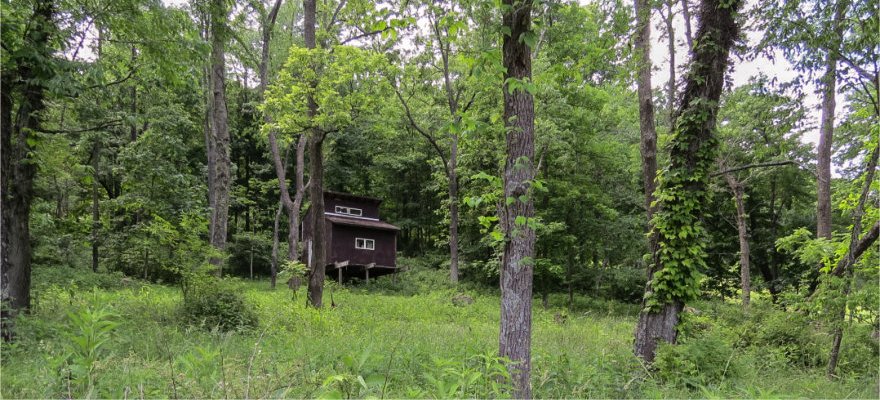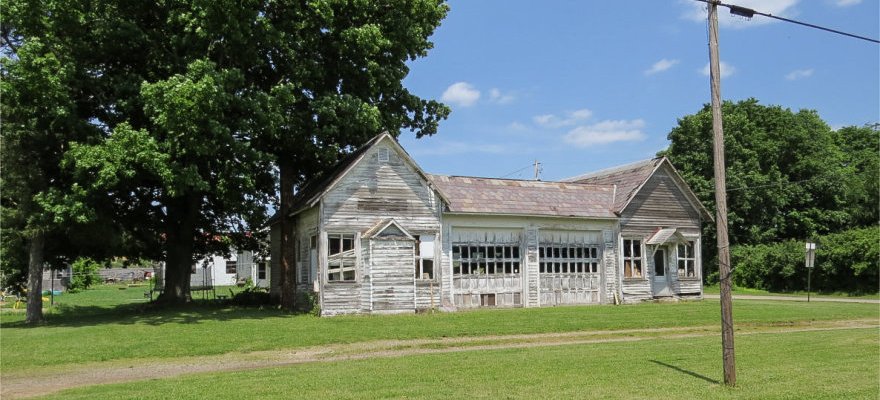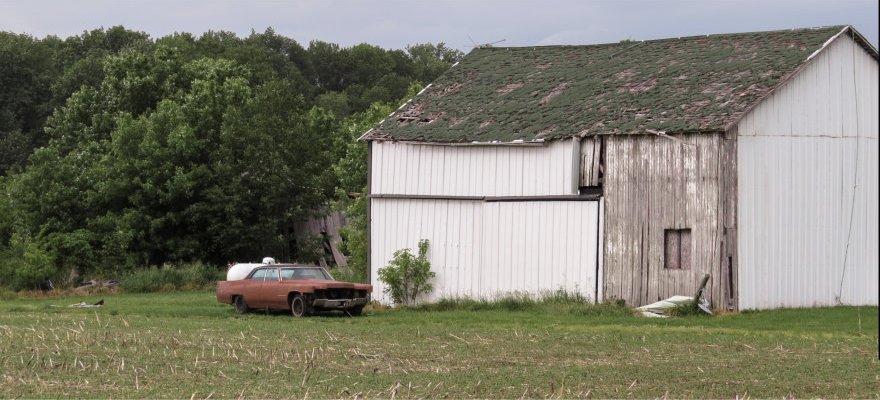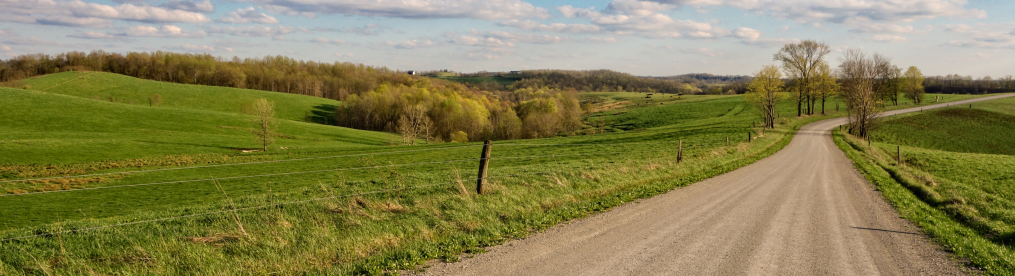
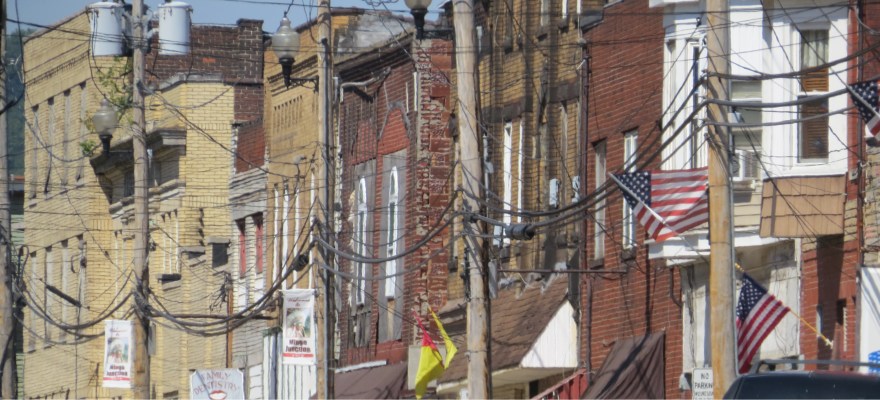
Excursion 15, Part 2 (The Ghosts of Steel)

In which our intrepid hero puts another notch on his Rust Belt…

When I was a young child, my parents took me to visit a ghost town, the old mining town of Mogollon (of Spanish origin, now pronounced muggy-own) in far west New Mexico in the Gila Mountains.  In the 1890s, Mogollon was a happening place, with thousands of residents who were involved, directly or indirectly, in the mining of gold and silver (the same mining that would give nearby Silver City its name).  However, by the 1920s, many of the mines had shut down and an exodus followed.  By 1930, its population was only around 200.   When the last nearby mine shut down in the 1950s, the remnants of its population blew away like dust.  When I visited the town, probably circa 1973 or so, it seemed to have been abandoned for a century.

That’s one type of ghost town.  But there’s another.

Continue reading

Excursion 14, Part 2 (Turn and Face the Strange)

In which our intrepid hero looks at some ch-ch-ch-ch-changes…

A few times when I was a kid, a neighbor of ours took his kids and me and my sister out into the desert outside El Paso to go “sand surfing.”  This involved taking the wheels off of a kid’s red wagon and tying the wheel-less wagon to the trailer hitch of a truck with four-wheel drive.  The truck would then go up and down some of the dirt roads and arroyos, dragging the wagon behind it, and you would be standing on the wagon, holding on to a rope also tied to the truck, hanging on for dear life and hoping that when you were finally bucked from the wagon you would not land on a cactus or rattlesnake or sharp rock.

Many years later, I reminisced about this to someone, who let me know of her sharp disapproval.  “Don’t you know how fragile the desert environment is?  Don’t you know how much damage you did to that ecology?”  Not being from El Paso, she didn’t understand, so I had to explain it to her.  “This was the desert right outside El Paso,” I said.  “That desert was only going to be there for a couple more years before development would swallow it up.”  This was because, thanks to geographic and other conditions, the tide of growth in El Paso is overwhelmingly in one direction, to the east.  And I was right.  What was desert for me back then vanished in the blink of an eye, to become three and four bedroom ranch houses.  And then the desert beyond that.  And the desert beyond that.  The rate of change in that place at that time was incredible.  Where I used to have to go to get out of the city into the desert is now miles and miles within the city itself.

Continue reading

Excursion 12, Part 3 (All Roads Lead to Coshocton)

In which our intrepid hero discovers a lonely house on a hill…

Having always basically been a city boy, some aspects of living in the country seem very different to me, including basic issues of convenience.  For example, for many years I lived in a townhouse apartment in Grandview, a Columbus neighborhood/incorporated town.  My apartment was not just in walking distance but within ridiculously easy walking distance of a grocery store, a pharmacy, several ATMs, a gas station, a number of restaurants from fast food to fancy, two bookstores, a couple of coffee places, two bakeries, a post office, a produce store, and much more.  I live in a more typical suburb now, which means that only a few things are that close, but essentially everything is just a short car ride away.  But if you live in the countryside, nothing is going to be close, and your options will be fewer.  There are many places in Ohio so far away from a gas station that unless you maintain a gas tank on your property you essentially have to plan when you are going to get gas.  Do you have a late night craving?  Better hope you took that into account when you bought groceries two weeks ago, because no store within many miles will be open.

Continue reading

Excursion 12, Part 2 (From Farm to Forest)

In which our intrepid hero  visits one of his frequent crossroads…

I have a long history with the television show “I Love Lucy.”  In fact, when I was three or four years old, “I Love Lucy” taught me a valuable lesson.  Sometime in 1969 or 1970 I was watching an episode of “I Love Lucy” and my mother walked into the room and announced that the family was going somewhere.  She turned off the television and we got into the car and left (I have no idea what the destination was).  When we returned, some time later, I turned the television on so that I could finish watching “I Love Lucy.”  But it wasn’t on!  That was when I discovered that when you turned the television off, the shows on TV did not stop playing but continued while you were not around!

Continue reading

Excursion 11, Part 2 (There and Back Again)

In which our intrepid hero reaches his destination and begins his return to the Shire…

One consequence of growing up in the desert is that I came to enjoy rainy days, rare as they are there.  This, I discovered, was an attitude quite foreign to people living in the Midwest, where I have lived for the past quarter-century.  Yet even so many years later, cloudy days do not depress me as they do so many others and I get a thrill every time a thunderstorm occurs.  Ohio gets its fair share of thunder and lightning, but the most impressive lightning show I ever saw occurred in El Paso one summer night in the mid-1980s.  I left the house that evening on some minor errand, driving on a wide-open street with an expansive view.  The storm had already begun and lightning lit up the entire sky.  Indeed, so many simultaneous lightning strikes were occurring each second that it was almost like an eerie artificial daylight.  I was virtually the only person on the road, so the whole display seemed as if it were some sort of special show just for me.  I have never forgotten that moment.

Continue reading

Excursion 9, Part 2 (Every Knee Shall Bow)

In which our intrepid hero encounters various signs of religious inclinations…

It goes without saying that religion is a touchy subject, as many deeply held beliefs can be.  My own perspective on religion is slightly unusual.  I was raised Catholic in a city with a significant Catholic population.  However, I still remember from my childhood being passed anti-Catholic comic books published by Jack Chick and being told by one Baptist that I was going to go to Hell for being a Catholic.  I became aware of religious prejudice at an early age.  However, religion did not “take” with me.  By the time I was an adult I had become an atheist.  Yet I always had a great many friends and relatives from a variety of religions whose opinions and perspectives I greatly respected.  Later, as I began professionally to get into the arena of studying (and combating) extremism, I became even more familiar both with religious prejudices as well as prejudices against people because of their religion.   And for more than a dozen years I have been working for a civil rights organization dedicated to fighting against such prejudices.

Continue reading

Excursion 9, Part 1 (South by Southeast)

In which our intrepid hero discovers people making hay while the sun shines…

Southeast Ohio has always appealed to me.  Geographically, it is one of the most interesting and diverse parts of Ohio.  It is also of cultural interest: Southeast Ohio in many ways is the heart of Appalachian Ohio (though strictly speaking, it is only one of three regions in the state that are technically considered Appalachian Ohio).  Appalachian Ohio is sparsely populated (the largest city in all three regions is Youngstown, Ohio, and the next largest city has fewer than 50,000 inhabitants) and economically depressed (especially Southeast Ohio; most of its counties are considered economically “at-risk” or even “distressed”).   Appalachian Ohio was originally settled by the same demographic groups of people who settled western Virginia and eastern Kentucky and as a result shares most of the elements of Appalachian culture with the Appalachians of other states.

Continue reading

Excursion 8, Part 7 (The Flatlands)

In which our intrepid hero enjoys the pleasures of the horizontal plane…

There’s more than one type of flat.  First, there’s Western Flat.  Western Flat may be very flat and it may be very flat for a very long way but typically there are mountains in the distance.  Among other things, this allows you to orient yourself.  Then there is Closed In Flat.  That’s when the country is flat but vision is obscured by buildings and/or trees.  When I moved from El Paso to Columbus I went from Western Flat to Closed In Flat.  You lose your bearings in Closed In Flat because there is nothing you can see with which to orient yourself.  I easily get lost in Closed In Flat if I am not familiar with the area.  Lastly, there is Open Flat.  That’s just plain flatness to the horizon.  Northwest and North Central Ohio is primarily Open Flat.  No hills, not much woods, just a lot of farmland.  That’s what I was driving through on this, the final leg of my eighth excursion.

Continue reading

Excursion 8, Part 1 (Lake Effect)

In which our intrepid hero encounters a reasonably great lake…

I grew up in the desert and as a result have always been fascinated by large bodies of water.  As a kid, I had never seen any body of water larger than the Caballo or Elephant Butte reservoirs in New Mexico.  When I was a freshman in college in San Antonio, I drove one night with friends to the Gulf of Mexico, but it was pitch black and I didn’t see a thing!  I don’t know how old I was before I ever saw an ocean.  So bodies of water—large rivers (the Rio Grande doesn’t cut it!), large lakes, oceans, bays, all of that stuff—is sort of like a fascinating foreign country to me.

Continue reading

Excursion 6, Part 2 (The Deception of Distance)

In which our intrepid hero encounters dead trees, dead cars and dead buildings…

One of the most interesting things about taking back-country drives is that the scale of everything changes.  The distance scale, for example, grows enormously.  Ohio is a relatively small state, and I am centrally located within it, so theoretically I can reach even the most distant parts of the state in three and a half hours.  But that is making a bee-line on a highway.  Once you start driving on curvy, back-country roads, especially driving relatively slowly to spot potential subjects for photographs (and stopping on occasion to actually take them), 20 miles somehow becomes a great distant, not a short jaunt.  Sixty miles is a huge distance.  On the other hand, the time scale slows down.  Because you are in no particular hurry, and paying attention to your surroundings rather than the clock, time passes quickly for you.  The combination of these two means that you can spend many, many hours in a vehicle and discover that you have really never driven more than 60 miles away from your starting point (though your total mileage may be much greater).

Continue reading